|
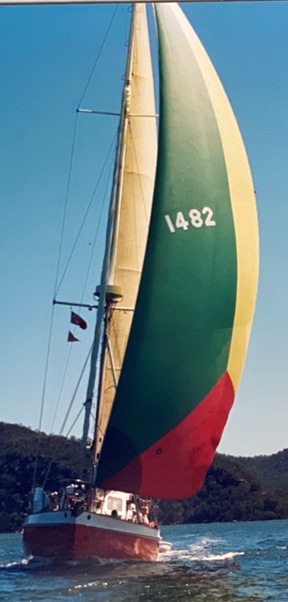
1. Tack (front), Head (top) and Clew (the “other” corner, usually at the rear).
2. Luff (front), Foot (bottom) and Leech (the “other” side, usually aft edge).
3. The throat halyard is attached to the inboard end of the gaff on a gaff rigged boat. It is used to raise the end of a gaff nearer to the mast
4. The Peak Halyard which is used to raise the other end of the gaff (it may not actually be at the end of the gaff – usually only part way along).
5. MARPOL (sometimes referred to as MARPOL 73/78) is the International Convention for the Prevention of Pollution From Ships, 1973 as modified by the Protocol of 1978. It is enacted in Australia under a number of national and state statutes and governs the discharge (or not) of everything including sewage, garbage, debris, oily wastes and many more. The various acts definitely apply to small vessels as well as to large.
6. The AVS is the angle of heel beyond which, in calm water, a boat will continue to roll rather than returning to the upright position.
7. Red with a white band is a dry powder extinguisher, whilst red with a black band is a carbon dioxide extinguisher.
8. No approach from behind a whale and no waiting in front. You can approach to a minimum of 100metres from the sides (300metres if a calf is present). In the caution zone (between 100 and 300 metres from a whale) vessels must travel at a constant slow speed and leave a negligible wake.
9. To indicate your position at night, and especially to avoid collision of another vessel which does not seem to notice you
10. An ornamental knot with a number of interwoven strands, forming a closed loop. Often used to denote the “straight ahead” position on a ship’s steering wheel, but other uses can include anti-chafing protection and to give a better grip on a pole or post. |