|
October 2026, Vol #46, no #8. Editor: Gerald Nicholls
|
| |
|
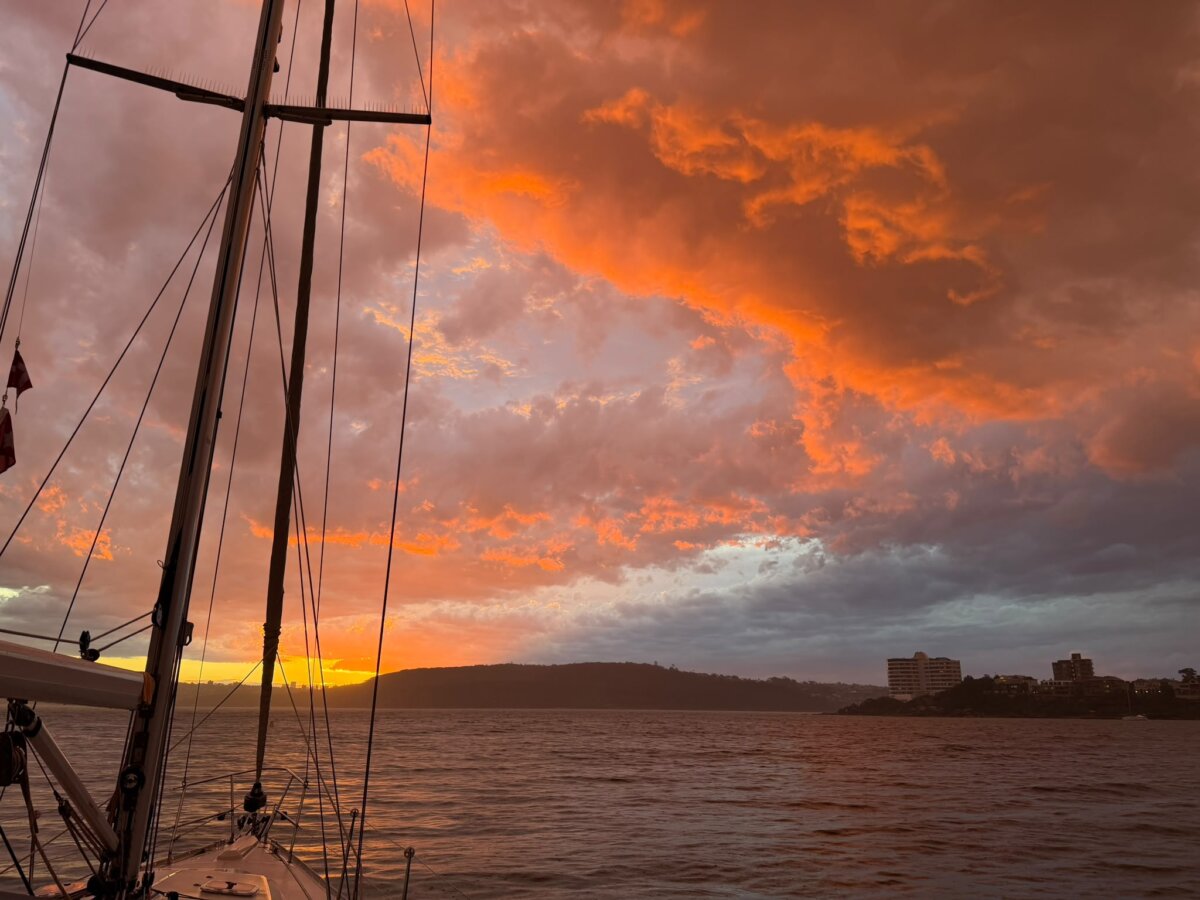
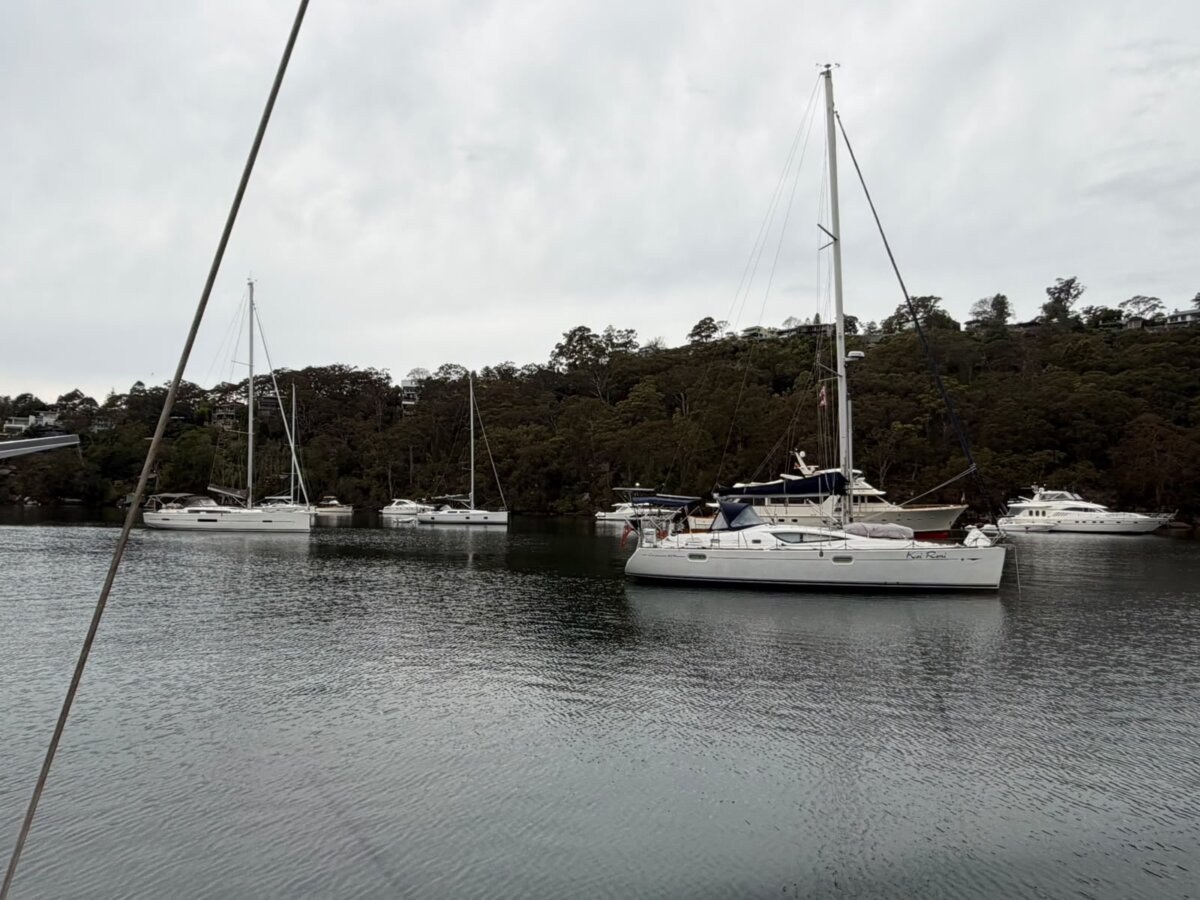
Storm clouds rolling across the harbour
Kelly Nunn-Clark |
| |
|
Images not showing? Click here to view the Compass Rose in your browser. |
| |
|
G’day Cruisers
The weather hasn’t been great in Sydney for the last week or so but we were still able to get 5 boats together for the October (Labour Day) long weekend cruise. We ended up staying inside the harbour rather than sailing up to Pittwater because of the weather but we still had a great time and I’ve included a bit of a write-up below and some pictures of what we got up to.
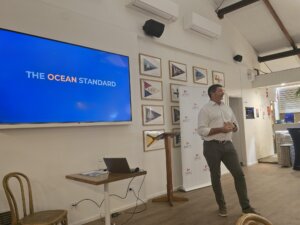
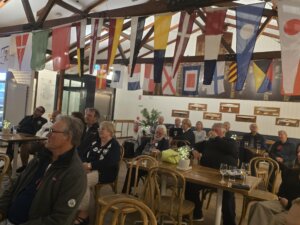
At our September meeting Andy (Forbes) MHYC CEO gave us a presentation on how he prepares a boat, and crew, for a cruise and or race. He then went on to share some of his experiences over his extraordinary career so far sailing all around the world on all sorts of boats. I’ve linked his presentation and added just a couple of pictures from the night. A very entertaining and educational presentation and much appreciated by everyone who was there on the night.
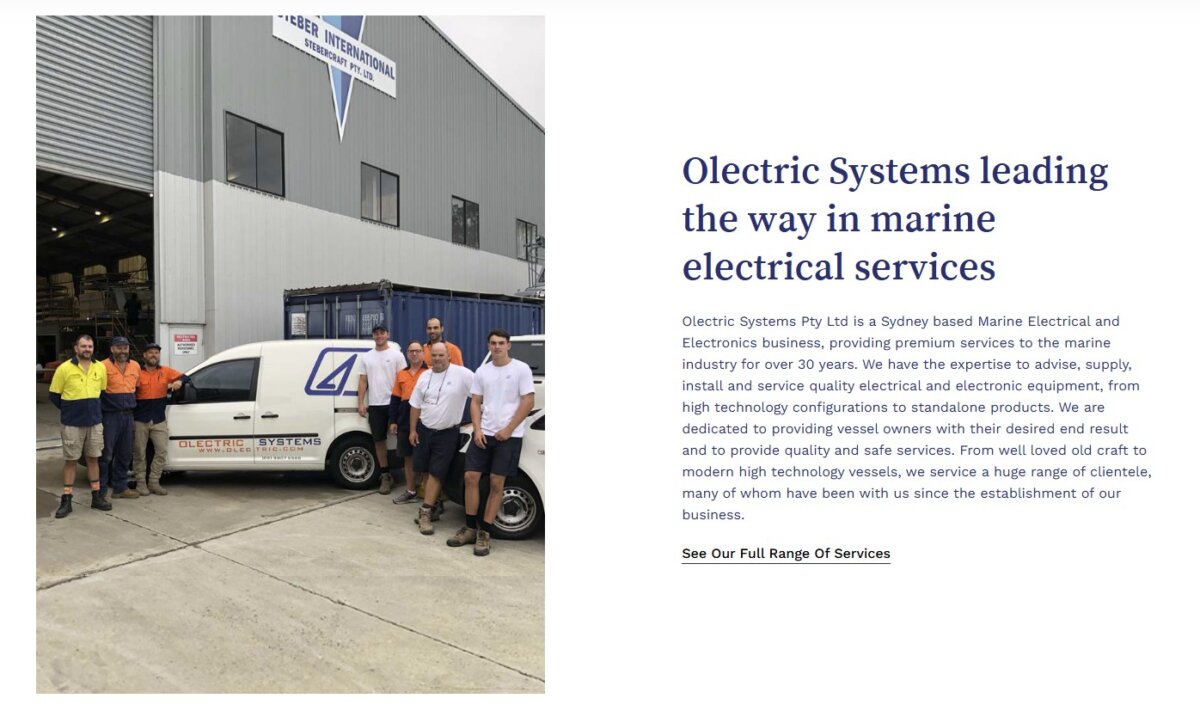
At our next meeting on 21st October, next Wednesday, Jeremy Clarke has organised a presentation from Olectric Systems who are very well known marine electricians and technicians around Sydney. They worked on Serenite after she was struck by lightning in 2023 and more recently on Kai Rani after she was struck by lightning also. The presentation will cover, lithium batteries, solar panels, alternators, instruments and electrolysis. Come along, have a listen and ask the experts any questions you might have.
We’ve changed the date of our Christmas Party back one day from Friday evening to Saturday afternoon 12th December. Jeremy and Kristin have volunteered to have the event at their house starting at 3pm. We’ll share more details closer to the event.
Another date for your diary is the sailability parents sail day which we’re having on Sunday 29th November. Again, more details closer to the day but the idea is that we will take the parents or carers out sailing at the same time as their person is sailing in the sailability dinghies from the club.
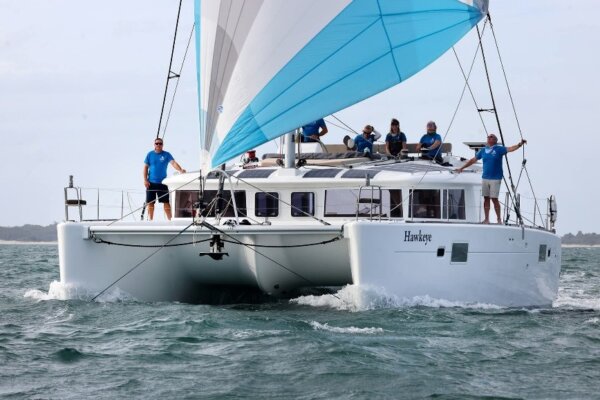
I’ve included a blog post from our friends Richard and Alexandra on Hawkeye which covers a bit of their time in Sydney and then the trip up the east coast of Australia until they headed off to Indonesia. I looked up their position yesterday and found them anchored off the island of Belitung over toward Sumatra. The link is at the end of the blog post.
Last column I again mentioned we’re keen to get any submissions anyone might have for technical corner so if you’re doing anything to your boat that you think others might be interested in I’d love to receive a description and some photos which I can share here.
Look forward to seeing you all next Wednesday night for the Olectric presentation.
Cheers,
Gerald |
| |
|
October Long Weekend Cruise
The weather forecast in the week leading up to the October (Labour Day) Long Weekend did not look promising. We’d originally planned to sail to Pittwater for the weekend but with strong winds and reasonable amounts of rain forecast it seemd like a much better idea to stay inside the harbour. Dallas and I hatched a plan to spend the Saturday night in Balls Head Bay and then maybe move to Blackwattle Bay for Sunday night but then the rain predicted for Saturday night got worse again.
In the end most of us decided to stay at home for the Saturday night but some brave souls on Sanctum and Kai Rani ventured out to Store Beach where they were the only boats. This is where the photo on the cover of this month’s newsletter comes from. Kelly saw 43 knots on the wind gauge as Saturday night’s storm passed over them while at anchor.
Sunday weather was much better with Kai Rani, Sanctum, Salty Lady and Dreamaway all heading outside for some whale watching and a lovely sail. Jenni and I got caught up on mother duty and didn’t make it to the boat until the afternoon. We all (except Dreamaway) then went through the 4.30pm bridge headed for Sugarloaf Bay. Unfortunately, Dreamaway had some unexpected start battery issues so had to wait for the next bridge. Chris and Jo are also dealing with the auto-pilot Dallas broke, but that’s another story.
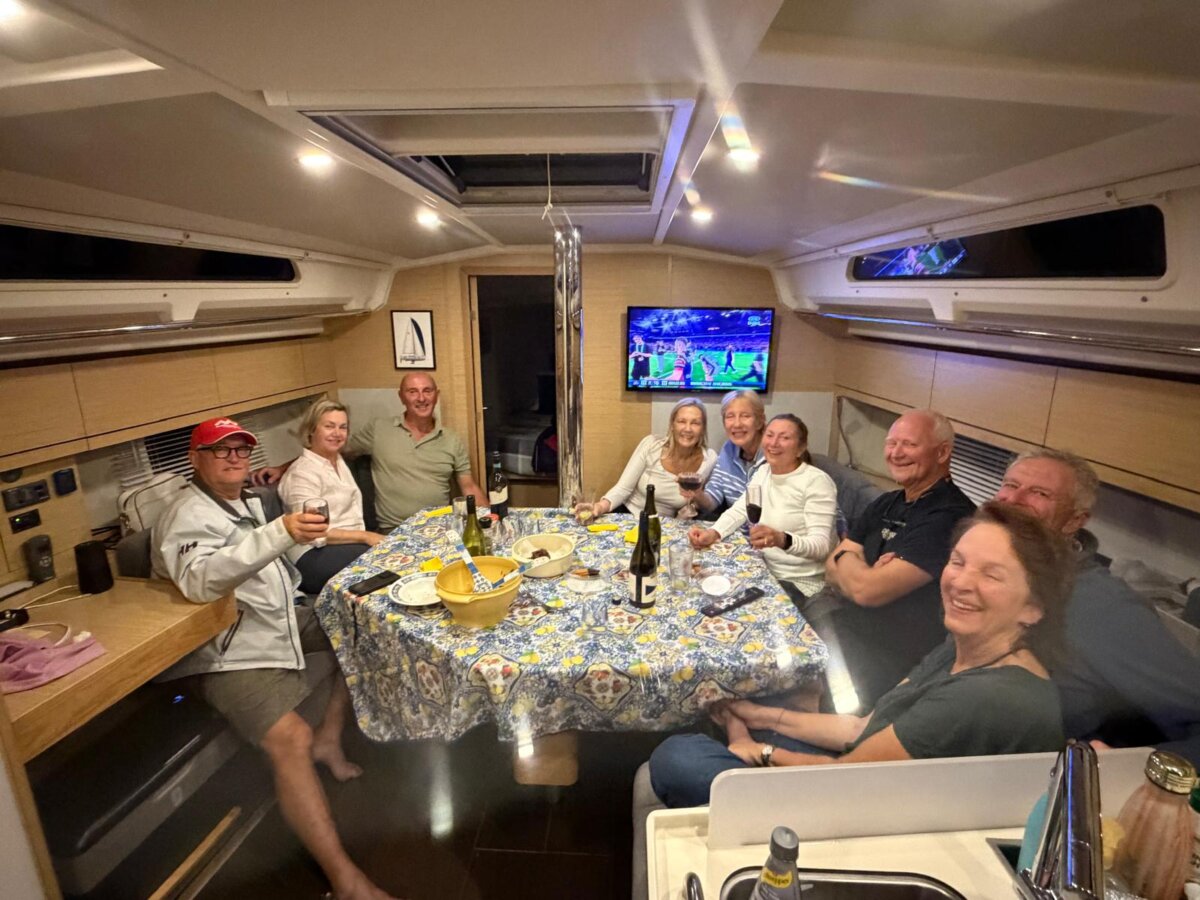
We all found a spot in Sugarloaf Bay which was dead calm as usual and settled down for the afternoon. Dallas and Selina on Salty Lady kindly invited everyone for sundowners which then turned into dinner. Everyone went back to their respective yachts, gathered their food and returned to Salty Lady where we sat around the massive dining table watching the NRL grand final. A great game of football but sadly the sentimental favourites lost.
|
| |
|
After a very peaceful night’s sleep it was back through the 11.30am bridge with Serenite back to our berth at MHYC but the others continued on for another night on the harbour. |
| |
|
September Cruising Division meeting presentation from our Club CEO Andy Forbes.
At our September meeting Andy provided a presentation on how he prepares both a boat and a crew for a race or passage.
We had more than 30 members and guests come along to listen to Andy's presentation and many people subsequently asked for a copy of his Offshore Safety Manual.
He was very clear to say:
This is certainly not intended to be a definitive manual or a prescriptive list of what every skipper must do. Every vessel, crew dynamic, and passage comes with its own requirements. This document was built specifically around one boat and one offshore race, reflecting systems and checklists that have served us reliably over many passages.
Please treat it simply as a practical example. Feel free to adopt what works, adjust elements to suit your own boat's layout and crew organisation, or discard whatever doesn't apply. If it helps prompt a useful onboard safety discussion before your next trip north or offshore weekend, it has done its job.
I hope you find a few handy takeaways in it. See you around the club and out on the water.
Download Andy's manual here
Odin Offshore Safety Manual July 2026 |
| |
|
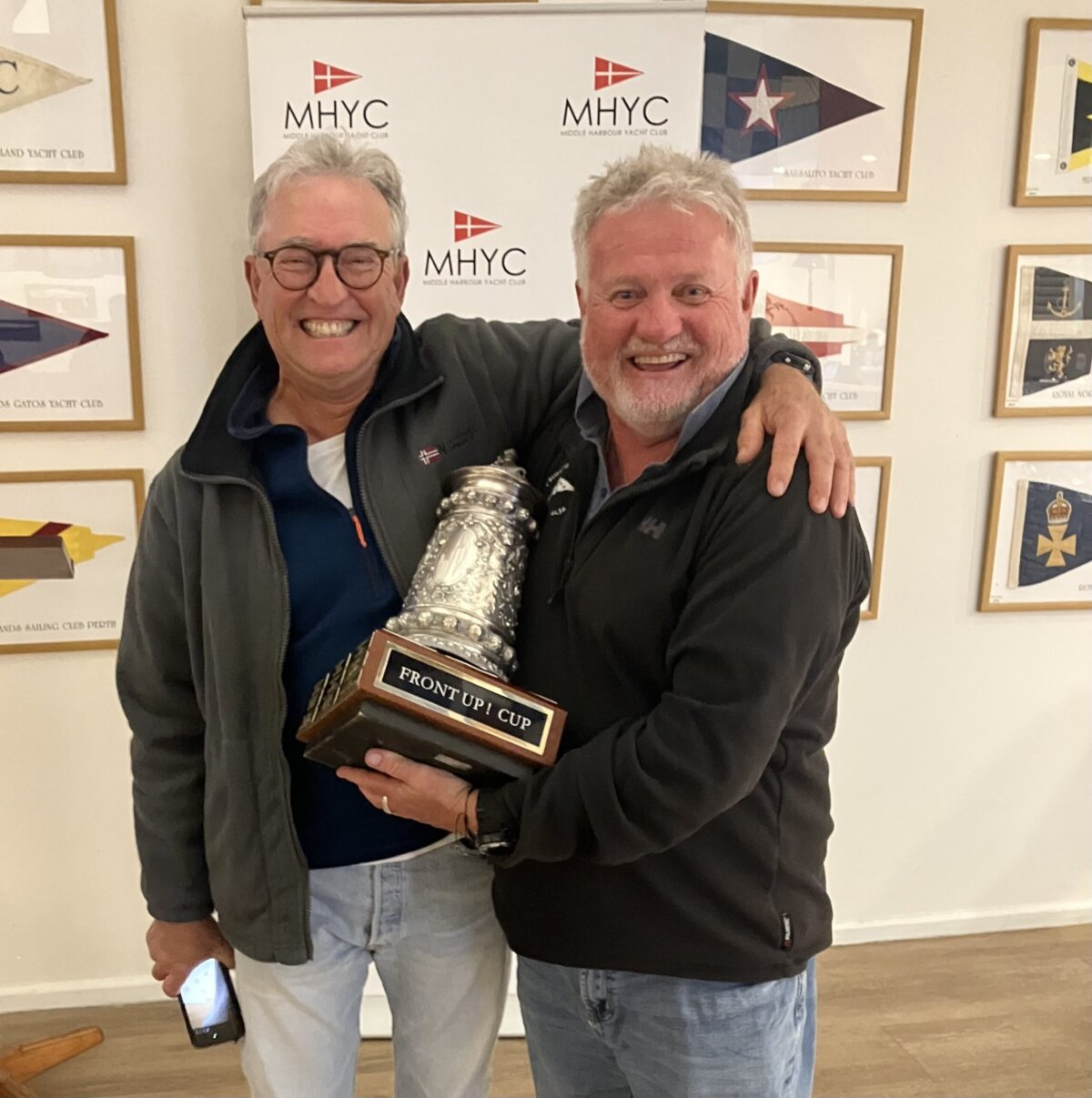
Commodore's Front up! cup
On 13 September the Commodore's Front up! cup saw two cruisers meet with great success.
- 1st in Division 1 - Shibumi - Bryan Moore
- 1st in Division 2 - Kai Rani - Jeremy Clarke
Well done gents |
| |
|
Come and see a presentation from Olectric Systems on lithium batteries, solar panels, alternators, instruments and electrolysis and put your questions to the experts. |
| |
|
Hawkeye Circumnavigation blog
Escaping the Great Barrier Reef
|
| |
|
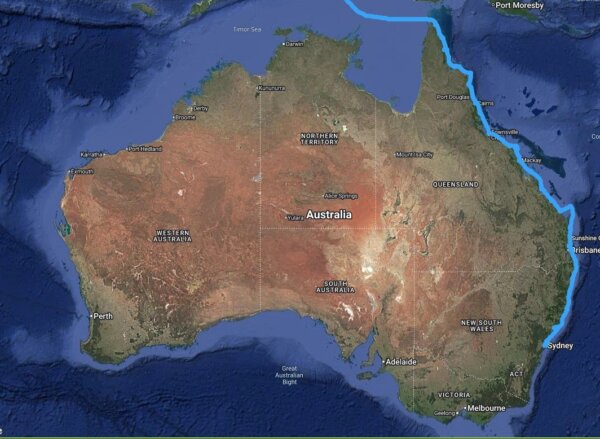
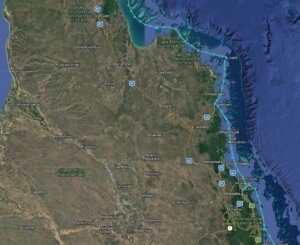
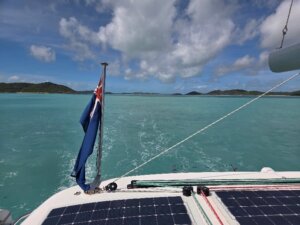
After four months in Sydney, the tropical cyclone season was drawing to a close, allowing Hawkeye to start sailing north, up the Australian coast, back into the tropics, and then onwards to Indonesia. The sheer size of Australia is hard to convey; it is over 2,000 miles sailing from Sydney to the north of Australia, further than from Cornwall to Africa! |
| |
|
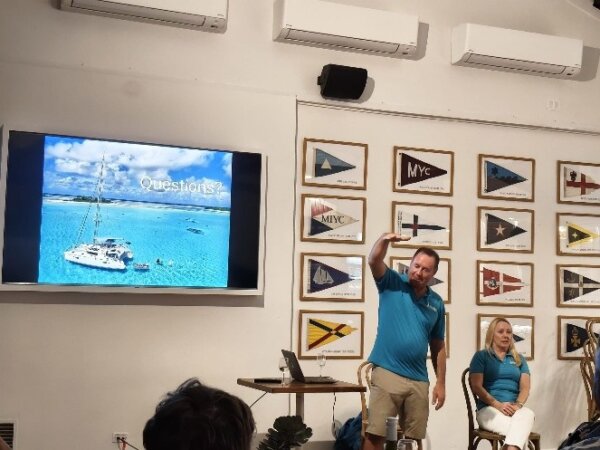
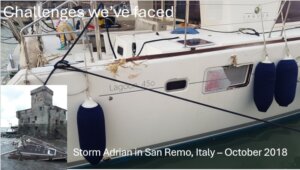
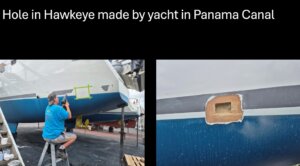
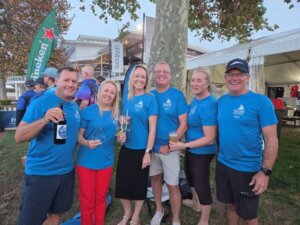
Before leaving our adopted home at Middle Harbour Yacht Club in Sydney, we gave their members a presentation on our circumnavigation. Although many had expected us to focus on idyllic anchorages and wonderful sailing conditions, the practical side of cruising life is really rather different, so we chose, instead, to focus on things that went wrong. Examples include being hit during a storm by a friend’s yacht in Italy whilst tied up in port and finding a puncture hole on the waterline made by another yacht in the Panama Canal. Together with the seemingly endless servicing and unexpected repairs, there is a constant stream of chatter between yacht crews about just how hard it is to maintain these boats. |
| |
|
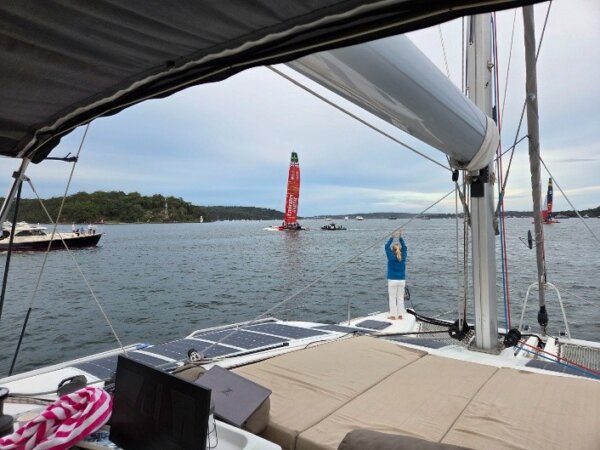
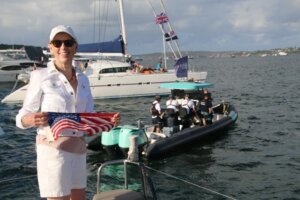
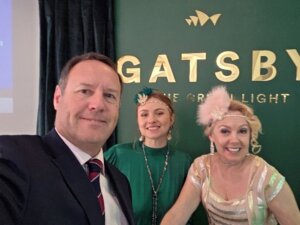
In the racing across Sydney Harbour, we watched the British Sail GP team get pushed into second place by the USA, which delighted Alexandra’s USA flag-waving mum Barbara. We enjoyed the obligatory visit to the Sydney Opera House, where Lizzie and Alexandra launched themselves into the swing of the Great Gatsby night. We were delighted to be awarded the Navigator’s Trophy by Middle Harbour Yacht Club, and the Flage Vagon trophy by the Royal Cornwall Yacht Club for the voyage of most merit. |
| |
|
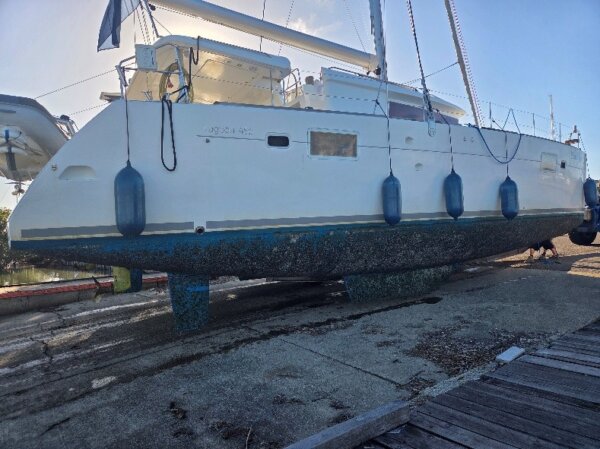
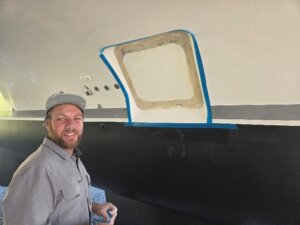
The fun soon stopped with a bump as Hawkeye was hauled out at Port Stephens, where, after many years of debate and consideration, Hawkeye’s emergency escape hatches were finally removed and the holes filled in by an excellent local shipwright. There is much controversy about these hatches, with no record of them ever saving anyone’s life on any catamaran, but there are, sadly, plenty of yachts, both monohulls and catamarans, which have sunk when the hatches have failed. Our insurers, Pantaenius, were happy we removed them! We don’t miss their leaks, nor, frankly, the terrifying sight of them being bombarded by massive seas with the thought that if (when?) they fail, we will be in serious peril. |
| |
|
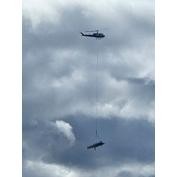
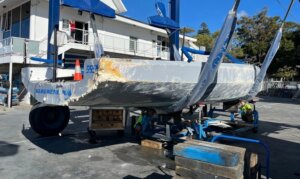
The Australian coast can be brutal as Kukukerchu, a Cape 31 race boat which, like Hawkeye, sailed up from Sydney for the Sail Port Stephens Regatta, soon found out when she hit the rocks at night. We were reminded of Australia’s incredible resources, as we listened on the VHF radio to their efficient rescue service kicking into gear. We were astonished the next morning to see that a helicopter had plucked Kukukerchu from the rocks and deposited her for repair in the shipyard next to us. |
| |
|
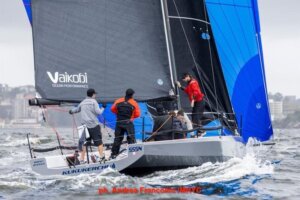
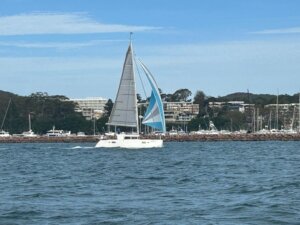
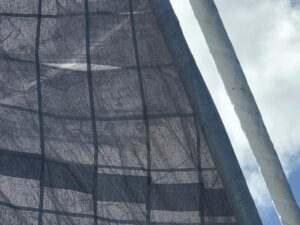
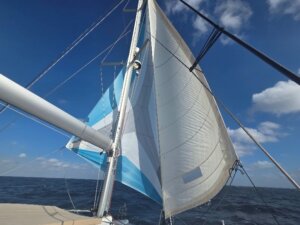
Hawkeye is probably as far from a racing boat as you can imagine, but we nevertheless managed to secure four top racing sailors from Sydney who helped Hawkeye achieve joint second in Australia’s largest regatta, Sail Port Stephens. Had there been a class for yachts competing with an integrated dishwasher then we surely would have won! Hawkeye has excellent 3Di moulded sails, made by North Sails, which allow her not just to sail faster but also to point closer to the wind. |
| |
|
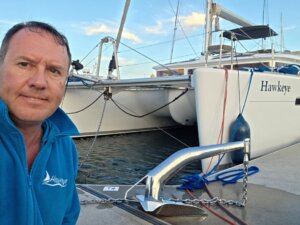
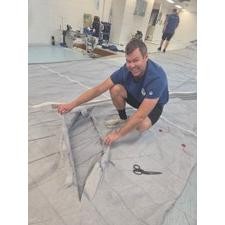
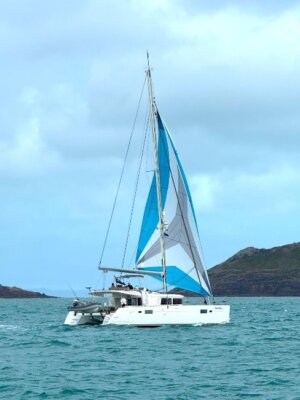
We then settled into day sails up the Australian coast, anchoring each night, but ran into a problem in one port when our anchor simply would not dig in and grip the sandy bottom. Eventually, when we pulled up the chain, we discovered to our horror that there was no anchor! One of the two screws that lock it to the chain had dropped out. We were not at all happy about that because the manufacturer, Ultra, are clear that “Together with the retaining setscrews which hold the pins in place, as no movement is possible to the pin itself, the setscrews themselves will not unwind over time”. After we pointed out where their engineering design had failed, they gave us a very substantial discount on a replacement, and luck turned in our favour when our next port, Brisbane, had one in stock. But our bad luck returned when we discovered that our victory in Sail Port Stephens Regatta had come at an unexpected cost; we had stretched our genoa beyond its breaking strain in the high winds, and it really was not very happy at all to have been treated like that. Luckily the loft at North Sails in Brisbane stepped in to repair it. |
| |
|
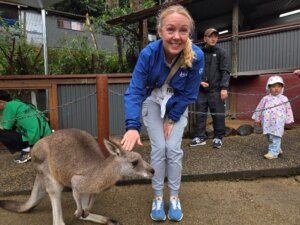
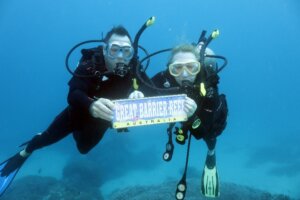
We pulled into Cairns, our final pit stop on the Australian mainland, where we filled up with cans of food and filled Hawkeye’s freezers, as the next port Hawkeye berths in will be Singapore, over four months later. We visited a park where they had wallabies and our all-time favourites, Koala’s. We took a dive on the Great Barrier Reef and met up for the first time with crews of the other yachts who are on the Sail to Indonesia Rally. |
| |
|
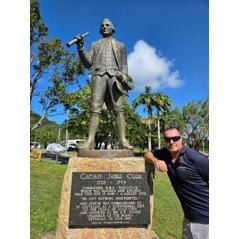
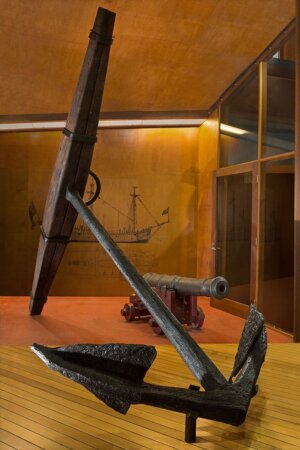
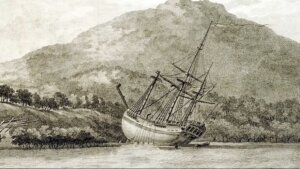
Leaving Cairns, we started our first encounters with the Great Barrier Reef. This is one of the most treacherous places in the world to sail, and as Captain Cook, on his first voyage around the world discovered to his cost, sailing these waters at night is a bad idea. We passed within a mile of where his ship, HMB Endeavour, hit the reef at night, and nearly sank. We anchored for the night just off a tiny sand spit called Hope Island, named by Captain Cook. Whilst his ship was impaled on the reef, Captain Cook could see this island, and his “hope” was that, somehow, they could extract Endeavour from the reef and beach her on the sand so that they could use pieces of the wreck to make a smaller boat and sail on to safety. After some amazing feats, including throwing the cannons, anchors and many ship’s stores overboard, his crew managed to refloat Endeavour by “fothering” the leak (covering it with a sail) and limped into what is now called Cooktown. After berthing Hawkeye on the tiny pontoon in Cooktown, we realised that she was just a few metres from where Cook had beached Endeavour. Whilst the ship was being repaired, Joesph Banks, the botanist on board, captured a kangaroo and took its preserved skin, and sketches, back to London where there was much astonishment that such a creature could really exist. In the Cooktown Museum we found Endeavour’s anchor and canon, which, quite astonishingly, had lain undisturbed for over 200 years until divers recovered them, intact, in 1971. Having followed in the footsteps of Captain Cook for some years, we do feel a certain affinity for him. |
| |
|
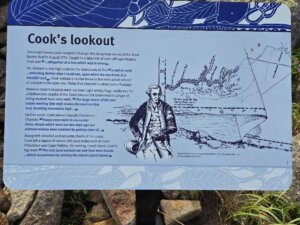
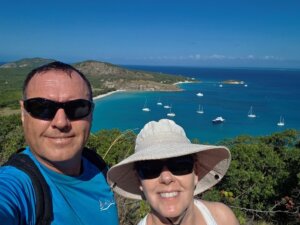
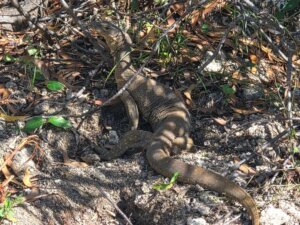
It’s not just the reefs that are treacherous; the Australian coast has deadly hazards for swimmers, including sharks, jellyfish and crocodiles. However, our next anchorage was Lizard Island which is (mostly) too far from the mainland for crocodiles, the most deadly jellyfish are (supposedly) out of season, and the waters are clear so sharks are (we are told) not an issue. We had our first snorkel since leaving Vanuatu almost a year earlier! It was a tricky and exhausting climb to the top of Lizard Island, where we met several of the yellow spotted monitors after which Captain Cook had named the island. The view from the top, called Cook’s Lookout, was spectacular, and just like the great man himself, we could also see the gap in the Great Barrier Reef that enabled Endeavour to escape back out into the comparative safety of the Pacific Ocean. |
| |
|
For Cook’s third and final voyage around the world, he chose as his ship’s master an unknown twenty-one-year-old, very young to hold that role, but selected for his exceptional talent in navigation and cartography, which was Cornishman William Bligh. As we sailed north, we came across Bligh Passage, which is where Captain Bligh, who as a result of his voyaging with Cook had been appointed Captain of HMS Bounty, managed to find a way into the relative shelter of the Great Barrier Reef after he was forced into a tiny boat by mutineers off Tonga. We also came across another gap in the reefs called Pandora Entrance, where, just two years after Bligh passed through, HMS Pandora sank on the Great Barrier Reef, forcing Captain Edward Edwards and the survivors, and the mutineers from the Bounty whom he had captured from Tahiti, into small boats.
Eventually, we sailed into the Torres Strait, at the very top of Australia, and anchored at Thursday Island. Neighbouring Wednesday Island was named by Captain Bligh, as he arrived there on a Wednesday. The next day he sailed to Thursday Island, and the following day Friday Island, before he sailed onwards for Batavia. Of these intrepid sailors there was little sign, but it was a very calm place to watch England in the World Cup, and for us to finally say goodbye to Australia, where we have spent over eight memorable months. |
| |
|
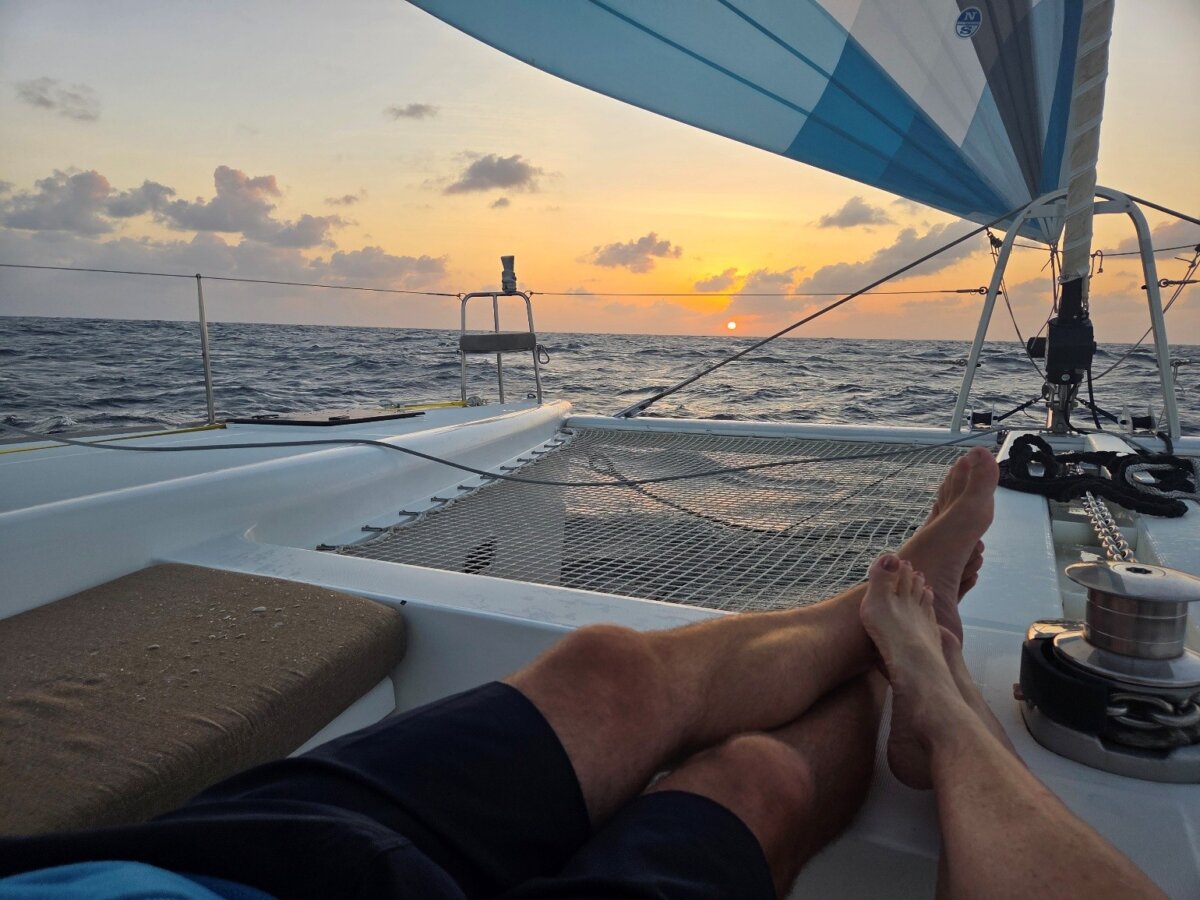
We left Australia with some regret, and not a little concern, as we were leaving behind three lane motorways, fully stocked supermarkets and our ever-friendly English-speaking cousins, for the total unknowns of Indonesia. As Thursday Island disappeared astern, we set up the “twins”, a genoa one side and a gennaker the other, and headed downwind to our next destination, some five days sail away, taking it in turns to keep watch. |
| |
|
As the sun set, we said a silent but fond farewell to all our Australian friends, and started to focus on our next landfall, which would be in the easternmost part of Indonesia, an area which is relatively isolated, very poor, and a totally different culture from Australia. |
| |
|
You can find Hawkeye’s position and telemetry data such as depth, wind etc, from her satellite tracker:
Hawkeye tracker |
| |
|
Cruising Quiz October by
Phil Darling
|
| |
- Where would you be if you are subject to the CEVNI regulations?
- If you make leeway on a starboard tack, would your course be greater or less than your heading?
- What could you use a sheepshank for?
- When visiting a foreign country in a sloop, where should the courtesy ensign (ie their national flag) be flown?
- If a vessel is not under command but underway, what lights should it show at night?
- What about in daylight – what should the not under command vessel display?
- From which level are overhead clearance heights (bridges, powerlines, etc) usually measured? Why?
- What marker has light characteristic Fl(2)? What colours is it painted, and what is it’s topmark?
- In a narrow channel a vessel sounds two long and one short blasts on it’s horn. What does this mean?
- What is the meaning of a blue and yellow vertically striped bouy?
|
| |
|
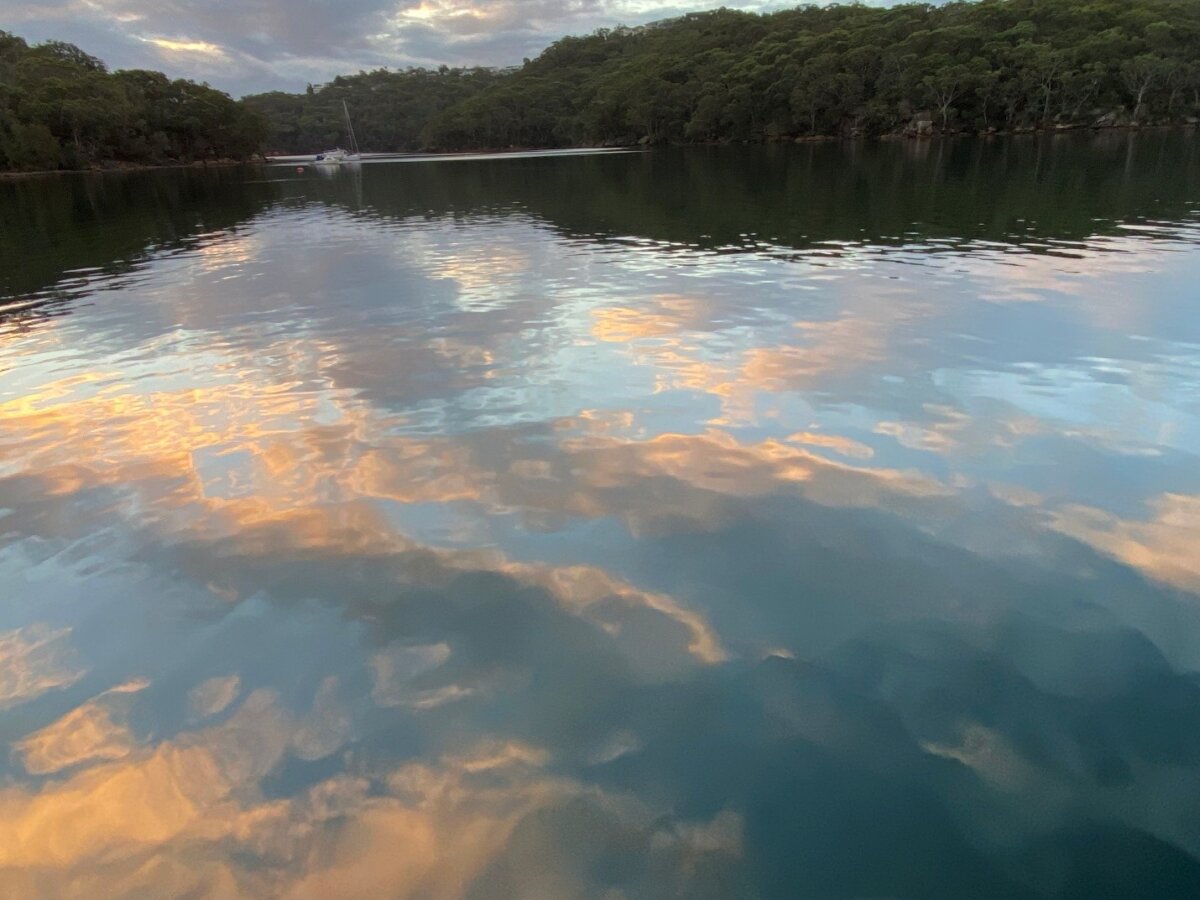
Reflections on Sugarloaf Bay
Guido Belgiorno-Nettis |
| |
|
Send your photos to Mike McEvoy to enter into the 2026 Cruising Division Competition. Each Month the best photo received will be published and, in the running, to win a new Mystery Prize at the end of 2026.
Send your best photos (as a JPG / JPEG) - Remember … to be in the running to win the prize you must be in it. Hint …. Give your favourite photo a Title and Place taken. Submit your photos to mmcevoy@bigpond.net.au
Good Shooting …!! Mike. |
| |
- CEVNI (Code Européen des Voies de la Navigation Intérieure – in English the European Code for Navigation on Inland Waterways) applies on the inland waterways of continental Europe. There some significant differences to the CollRegs that we are all most used to.
- Less – the wind will push you further to port.
- A sheepshank knot is mostly used to shorten a length of rope temporarily, maybe to strengthen a section of damaged line. However it is not a stable knot and you may wish to lash or seize the loops to prevent it falling apart if the load fluctuates.
- Starboard cross tree, superior to all other flags except for the yacht’s own national flag.
- Two red lights in a vertical line (signifying not under command), plus red/green sidelights and stern light (signifying underway). Note that CollRegs rule 27 does not permit a steaming light (this is replaced by the two vertical red lights).
- Two balls or similar shapes in a vertical line where they can best be seen.
- Check your chart to be sure, but they are generally measured from MHWS (Mean high Water Springs) or HAT (Highest Astronomical Tide) and thus give a minimum clearance.
- An isolated danger mark. It is painted red and black, and has two black balls as it’s topmark.
- I intend to overtake you on your starboard side. The vessel to be overtaken should indicate agreement by giving one prolonged, one short, one prolonged and one short blast, in that order (CollRegs rule 34).
- This is an emergency wreck marker – so beware of a serious (hopefully temporary) obstruction.
|
| |
|
CRUISING DIVISION OFFICE BEARERS 2026 - 2027
|
| |
|
Here are the current members of the committee:
| Cruising Captain |
Gerald Nicholls |
0413 590 243 |
| Secretary |
Kelly Nunn-Clark |
0457 007 554 |
| Treasurer |
Niclas Westling |
0476 152 800 |
| Safety Coordinator |
Phil Darling |
0411 882 760 |
| Committee Member |
Martyn Colebrook |
|
| Committee Member |
Evan Hodge |
|
| Committee Member |
Jeremy Clarke |
0412 601 911 |
| Committee Member |
Dallas O'Brien |
|
| Committee Member |
Susanna Westling |
| | |
|
Opinions expressed in the Compass Rose are those of the contributors, and do not necessarily reflect opinions of either Middle Harbour Yacht Club or the Cruising Division
|
|
| |
Middle Harbour Yacht Club
75 Lower Parriwi Road, The Spit, Mosman NSW 2088
Copyright © 2023 MHYC. All Rights Reserved.
| |
|