|
1. A sailing vessel is “in irons” when it is stationary head to wind and unable to pay off on either tack. This was a major problem with square rigged ships (and, to a lesser extent, on vessels without a headsail as the usual solution is to back the headsail and spin the bow away from the wind).
2. They prevent the lifejacket from riding up and keep the wearer’s face above water.
3. This signifies that, at night time, the marker has a light showing two white flashes.
4. It is an Isolated Danger mark, signifying that there is a dangerous hazard surrounded by navigable water.
5. Colours are Black over Red over Black; if there is a top mark is consists of two black balls one over the other.
6. Seelonce Feenee.
7. A “Tidal Gate” is an area where safe passage is much easier if you work with, rather than against, the tide. For example, Solway Pass (between two of the Whitsunday islands) is much safer and easier to pass through on Slack Water (ie at the top or bottom of the tide) rather than at mid tide when strong currents and overfalls are common.
8. An Overfall is a turbulent stretch of water caused by a strong current or tide. It may be from a meeting of currents, or from an effect from the shape of the sea bed. The writer has experienced them in the Whitsunday region.
9. High pressure can depress tidal heights ie both high and low tide height are lower than otherwise expected.
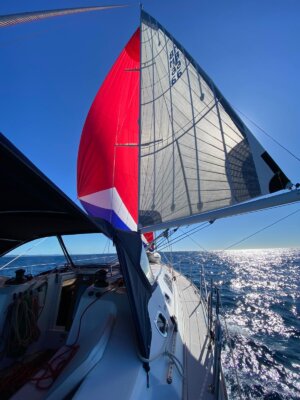
10.Not in the galley (I hope) - It is the curved area at the back of the sail outside of the line from head to clew. |